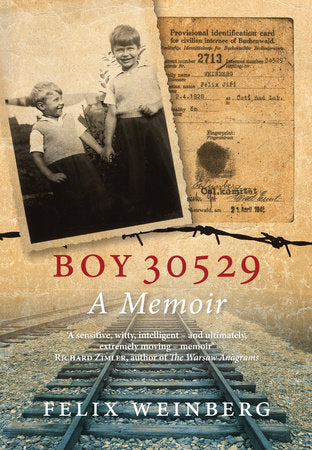
Boy 30529 Paperback by Felix Weinberg
Boy 30529 Paperback by Felix Weinberg
Product Details
- Publisher: Verso (2014-03-04)
- Language: English
- Paperback: 192 pages
- ISBN-13: 9781781683002
- Item Weight: 215.46 grams
- Dimensions: 7.9 x 5.1 x 0.6 cm
A Holocaust survivor reflects on his childhood in Nazi concentration camps, and the hardships of being a postwar refugee, in this deeply moving memoir written with surprising wit and humor.
“Weinberg’s graphic memories are haunting . . . an essential title for discussion.” —Booklist
In 1939, 12-year-old Felix Weinberg lost everything: hope, home, and even his own identity. Born into a respectable Czech family, Felix’s early years were idyllic. But when Nazi persecution threatened in 1938, his father travelled to England, hoping to arrange for his family to emigrate there. His efforts came too late—and his wife and children fell into the hands of the Fascist occupiers.
Thus begins a harrowing tale of survival, horror, and determination. Over the following years, Felix survived 5 concentration camps, including Terezín, Auschwitz and Birkenau, as well as the Death March from Blechhammer in 1945. Losing both his brother and mother in the camps, Felix was liberated at Buchenwald and eventually reunited at the age of 17 with his father in Britain, where they built a new life together.
An extraordinary memoir, as well as a meditation on the nature of memory. It helps us understand why the Holocaust remains a singular presence at the heart of historical debate.
About the Author
Felix Weinberg was a Holocaust survivor from Czechoslovakia who settled in Britain after the war. Despite his formal education having been cut short at age twelve, he won a place at university and later become the first professor of Combustion Physics at Imperial College London. He was also a fellow of the Royal Society. He was the author or editor of four books and more than 220 scientific papers. Internationally acknowledged as a leading thinker in his field, he was awarded a D.Sc. by the University of London (1961), both the Silver (1972) and the Bernard Lewis Gold (1980) Medals of the Combustion Institute, Fellowship of the Royal Society (1983), the Royal Society’s Rumford Medal (1988), the D.Sc. Honoris Causa by Technion, Haifa (1990), the Italgas Prize for Energy Sciences (Turin Academy, 1991), and the Smolenski Medal of the Polish Academy of Science (1999), as well as being elected to the American National Academy of Engineering as a Foreign Associate in 2001. The Hugh Edwards Lifetime Achievement Award for contributions to Combustion Physics was conferred on him in 2005 (Institute of Physics). He died in December 2012.
Share