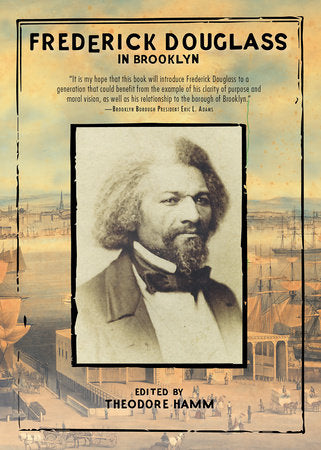
Frederick Douglass in Brooklyn Paperback by Frederick Douglass; Theodore Hamm
Frederick Douglass in Brooklyn Paperback by Frederick Douglass; Theodore Hamm
Product Details
- Publisher: Akashic Books, Ltd. (2017-01-10)
- Language: English
- Paperback: 224 pages
- ISBN-13: 9781617754852
- Item Weight: 368.55 grams
- Dimensions: 0.0 x 0.0 x 0.0 cm
A fascinating collection of Frederick Douglass's always-controversial speeches in Brooklyn, New York.
“In Frederick Douglass in Brooklyn, Theodore Hamm persuasively and passionately makes the case that the borough (and former city) became a powerful forum for Douglass’s abolitionist agenda in the mid-19th century after he escaped slavery in 1838.” —New York Times
This volume compiles original source material that illustrates the complex relationship between Frederick Douglass and the city of Brooklyn. Most prominent are the speeches the abolitionist gave at the Brooklyn Academy of Music, Plymouth Church, and other leading Brooklyn institutions. Whether discussing the politics of the Civil War or recounting his relationships with Abraham Lincoln and John Brown, Douglass’s towering voice sounds anything but dated. An introductory essay examines the intricate ties between Douglass and Brooklyn abolitionists, while brief chapter introductions and annotations fill in the historical context.
Frederick Douglass (1818–1895) was an abolitionist leader, spokesman for racial equality, and defender of women’s rights. He was born into slavery in Maryland and learned to read and write around age twelve, and it was through this that his ideological opposition to slavery began to take shape. He successfully escaped bondage in 1838. In 1845, he published his first autobiography, Narrative of the Life of Frederick Douglass, an American Slave, which became a best seller in the US and was translated into several languages. He went on to advise President Abraham Lincoln on the treatment of black soldiers during the Civil War and continued to work for equality until his death.
About the Author
Frederick Douglass (1818–1895) was an abolitionist leader, spokesman for racial equality, and defender of women’s rights. He was born into slavery in Maryland and learned to read and write around age twelve, and it was through this that his ideological opposition to slavery began to take shape. He successfully escaped bondage in 1838. In 1845, he published his first autobiography, Narrative of the Life of Frederick Douglass, an American Slave, which became a bestseller in the US and was translated into several languages. He went on to advise President Abraham Lincoln on the treatment of black soldiers during the Civil War and continued to work for equality until his death.
THEODORE HAMM is chair of journalism and new media studies at St. Joseph’s College in Clinton Hill, Brooklyn. His previous books include Rebel and a Cause, The New Blue Media, and Pieces of a Decade (coedited with Williams Cole). Hamm’s writings about New York City history and politics have appeared recently in the Village Voice, Vice News, the New York Daily News, and Jacobin. He lives in Sunset Park, Brooklyn. He is the editor of Frederick Douglass in Brooklyn.
Share