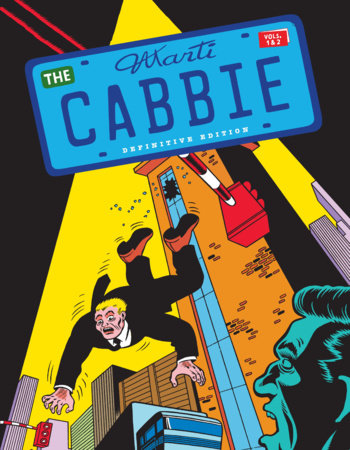
The Cabbie Paperback by Martí Riera Ferrer
The Cabbie Paperback by Martí Riera Ferrer
Product Details
- Publisher: Fantagraphics (2025-04-29)
- Language: English
- Paperback: 196 pages
- ISBN-13: 9798875000591
- Item Weight: 873.18 grams
- Dimensions: 29.21 x 22.73 x 1.45 cm
Take Chester Gould’s Dick Tracy, add steroids, teleport it to Spain… and you have The Cabbie!
Sergio Leone’s retooling of classic westerns for his “spaghetti westerns”… Stieg Larsson’s striking take on the serial killer/mystery thriller in The Girl With the Dragon Tattoo… And for that matter ABBA’s fiendishly catchy appropriation of American pop music. Sometimes it takes Europeans to make gold of tuckered-out American tropes.
Add to those instances of inspired global cross-pollination the Spanish cartoonist Martí’s eye-popping The Cabbie, which spins off Martin Scorsese’s sordid urban-justice drama Taxi Driver with a graphic style that unapologetically appropriates and even refines the brutal slabs of black, squashed perspectives, and grotesque approach to human physiognomy (and its ability to withstand punishment) that define Chester Gould’s Dick Tracy.
And as Art Spiegelman (who was the first to publish Martí’s work in English, in RAW magazine) notes in his introduction, while “Gould’s graphic black and white precision and his diagrammatic clarity live on in Martí’s work,” he points out that “more interestingly, perhaps, so does Gould’s depravity.” Indeed, if anything, The Cabbie is even more savage than the legendarily brutal Dick Tracy, with its pimps, whores, petty thieves, corrupt businessmen, all swirling around the ingenuously violent “Cabbie” whose self-administered “upstanding citizen” status entitles him — in his view — to even more shocking acts of violence — especially on his quest for the stolen coffin of his father, which he’s told includes his entire inheritance!
About the Author
Spanish cartoonist Martí Riera Ferrer (1955–2024), better known as Martí, was born in Barcelona. A major figure in the Spain’s underground comics movement of the 1980s, his work appeared in the comics anthology magazine for adults El Vibora (which is analogous to and roughly contemporaneous with Raw magazine, in which some of his stories appeared, and Art Spiegelman’s Maus was first serialized).
Art Spiegelman is one of the world’s most admired and beloved comic artists, best known for his Pulitzer Prize-winning Holocaust narrative, Maus. Born in Stockholm in 1948, Spiegelman studied art and philosophy at Harpur College before joining the underground comics movement in the 1960s. Spiegelman taught history and the aesthetics of comics at the School of Visual Arts in New York from 1979 to 1986, and in 1980 he founded RAW, the acclaimed avant-garde comics magazine, with his wife, Françoise Mouly. Honors Spiegelman has received include induction into the Will Eisner Hall of Fame and the Art Director’s Club Hall of Fame. In 2005, he was named one of Time magazine’s 100 Most Influential People. He was made an Officier de l’Ordre des Arts et des Lettres in 2007, and in 2011 he was awarded the Grand Prix at the Angoulême International Comics Festival. In 2015, he was elected to the American Academy of Arts and Letters, and in 2018 he became the first comic artist to receive the Edward MacDowell Medal.
Share